RAII in High-Performance C++
“The constructor acquires, the destructor releases — and everything in between is guaranteed safe.”
What Is RAII?
RAII (Resource Acquisition Is Initialization) is a programming idiom — originating in C++ — in which the lifetime of a resource is bound to the lifetime of an object. When the object is constructed, it acquires (or opens, or locks) a resource; when the object is destroyed, it releases (or closes, or unlocks) that resource. Because C++ guarantees that destructors run when objects go out of scope, RAII transforms manual, error-prone resource management into something the compiler enforces.
The Core Guarantee
Object created  →  Resource acquired  (constructor)
Object alive    →  Resource is valid   (invariant)
Object destroyed → Resource released   (destructor)
This contract eliminates entire classes of bugs: resource leaks, double-frees, use-after-close, and deadlocks from forgotten mutex unlocks.
The Formal Invariant
At a precise level, RAII establishes a class invariant — a logical predicate that is true from the moment construction completes until the moment destruction begins:
For every object o of RAII type T:
  post(T::T())  ⟹  resource(o) is valid
  pre(T::~T())  ⟹  resource(o) is valid
  post(T::~T()) ⟹  resource(o) is released
This means:
- If the constructor succeeds (doesn’t throw), the object holds a valid resource.
- If the constructor fails (throws), no object exists, no destructor is called, and no resource leaks — because the resource was never fully acquired.
- The destructor is the sole point of release. Client code never calls
release()orclose()manually.
Why SBRM over Garbage Collection?
In high-performance computing (HPC), memory footprint and execution determinism are paramount. Scope-Bound Resource Management (SBRM) is chosen over Garbage Collection (GC) for several key reasons:
- Determinism: Destructors run exactly when an object leaves its scope (block, function, or parent class destruction). There is no “stop-the-world” sweep or unpredictable latency.
- Resource-Agnosticism: GC only manages heap memory. RAII manages any resource (GPU memory, file locks, network sockets, file streams, thread execution pools).
- No Runtime Overhead: Standard RAII types like
std::unique_ptrcompile down to raw pointers with no metadata or tracking overhead.
The Problem: Manual Memory Management in HPC
In high-performance systems, engineers often deal with raw float or double buffers on the CPU or GPU. Manual resource management in these settings leads to a combinatorial explosion of error-handling paths.
The Combinatorial Cleanup Path (Diamond of Death)
When a function acquires multiple raw buffers, the number of error-handling paths grows as O(2ⁿ) with n resources. If you allocate a buffer for inputs, another for weights, and a third for intermediate outputs, any allocation failure midway requires freeing all previously allocated buffers.
graph TD
    Start([Start run_kernel]) --> AllocA[malloc R1]
    AllocA -->|Failure F1| ReturnFail1[return -1]
    AllocA -->|Success| AllocB[malloc R2]
    AllocB -->|Failure F2| FreeR1[free R1] --> ReturnFail2[return -1]
    AllocB -->|Success| AllocC[malloc R3]
    AllocC -->|Failure F3| FreeR2[free R2] --> FreeR1
    AllocC -->|Success| Comput[Compute] --> FreeR3[free R3] --> FreeR2
The goto cleanup Workaround in C
C programmers (such as in CUDA or MPI codes) use a structured goto pattern to centralize cleanup:
int run_kernel(const double* inputs, size_t size) {
    int status = -1;
    double* buffer_a = NULL;
    double* buffer_b = NULL;
    double* buffer_c = NULL;

    buffer_a = (double*)malloc(size * sizeof(double));
    if (!buffer_a) goto cleanup;

    buffer_b = (double*)malloc(size * sizeof(double));
    if (!buffer_b) goto cleanup;

    buffer_c = (double*)malloc(size * sizeof(double));
    if (!buffer_c) goto cleanup;

    // ... run calculation ...
    status = 0; // success

cleanup:
    free(buffer_c);
    free(buffer_b);
    free(buffer_a);
    return status;
}
This pattern centralizes resource cleanup, but introduces severe drawbacks in C++:
- Dangling pointers: If you reorder the
gotolabels or forget to set pointers toNULL, you trigger double-frees or undefined behavior. - Incompatible with Exceptions: If a C++ library function (like
std::vector::push_backor a math routine) throws an exception within the body, the stack unwinds and bypasses thecleanup:label entirely, leaking all allocated memory. - No Reuse: Every function must write its own verbose
goto cleanupboilerplates.
Custom RAII Resource Wrappers: The LinearArena Example
To avoid manual tracking and exception leaks, we wrap raw memory allocations inside a custom RAII type. For example, a custom LinearArena can serve as an allocator that pre-allocates a single contiguous memory block and bumps an internal offset to hand out sub-blocks.
Here is the implementation of the LinearArena RAII wrapper:
#include <cstdint>
#include <cstdlib>
#include <new>
#include <utility>

class LinearArena {
private:
    uint8_t *buffer_;
    size_t capacity_;
    size_t offset_;

public:
    // Constructor: Acquires the resource
    explicit LinearArena(const size_t capacity)
        : buffer_(static_cast<uint8_t *>(std::malloc(capacity)))
        , capacity_(capacity)
        , offset_(0)
    {
        if (buffer_ == nullptr) {
            throw std::bad_alloc(); // Throws on allocation failure
        }
    }

    // Destructor: Releases the resource
    ~LinearArena() {
        std::free(buffer_); // Guaranteed to run at scope exit
    }

    // Allocation logic using a fast bitwise alignment padding
    uint8_t *allocate(size_t bytes, size_t alignment = 16) {
        // alignment must strictly be a power of 2!
        size_t aligned_offset = (offset_ + alignment - 1) & ~(alignment - 1);

        if (aligned_offset + bytes > capacity_) {
            throw std::bad_alloc();
        }

        uint8_t *current_ptr = buffer_ + aligned_offset;
        offset_ = aligned_offset + bytes; // Bump offset forward
        return current_ptr;
    }

    void reset() { offset_ = 0; } // Instant O(1) bulk deallocation

    // Copy semantics are deleted to prevent double-free of the same buffer_
    LinearArena(const LinearArena &) = delete;
    LinearArena &operator=(const LinearArena &) = delete;

    // Move semantics are implemented to allow ownership transfer (detailed in Section 4)
    LinearArena(LinearArena &&other) noexcept;
    LinearArena &operator=(LinearArena &&other) noexcept;
};
The RAII Advantage
If an exception occurs within a function using LinearArena, the compiler automatically generates code to call ~LinearArena(). The entire memory block is freed, preventing leaks.
void train_model(size_t batch_size) {
    LinearArena arena(1024 * 1024 * 64); // Allocate 64MB on the stack (via RAII)

    double* x = reinterpret_cast<double*>(arena.allocate(batch_size * sizeof(double)));
    double* y = reinterpret_cast<double*>(arena.allocate(batch_size * sizeof(double)));

    // If compute_gradients throws std::invalid_argument,
    // the stack unwinds and calls ~LinearArena(), freeing the 64MB buffer safely.
    compute_gradients(x, y, batch_size);
}
Move Semantics & The Rules of Three, Five, and Zero
C++ manages resource lifetimes by binding them to object lifetimes. How those objects behave when copied or moved dictates the safety of the resource.
The Rule of Three (Pre-C++11)
In older versions of C++, if your class managed a resource manually (e.g., a raw pointer) and you defined a destructor, you had to write copy operations to prevent double-freeing:
- Destructor: Releases the resource.
- Copy Constructor: Performs a deep copy (allocates a new buffer and copies contents).
- Copy Assignment Operator: Releases current resource, allocates a new buffer, and copies contents.
For resource wrappers like LinearArena, copying the arena is conceptually invalid (or extremely expensive), so copy operations are deleted.
The Rule of Five (C++11 onwards)
With C++11 and move semantics, the Rule of Three expanded to the Rule of Five to support efficient ownership transfer of non-copyable resources:
- Destructor
- Copy Constructor (deleted)
- Copy Assignment Operator (deleted)
- Move Constructor (steals resources from a temporary, setting its handle to a safe/null state)
- Move Assignment Operator (cleans up current resource, then steals)
Here is the move constructor and assignment operator implementation for LinearArena:
// Move Constructor: Transfer ownership of the raw buffer
LinearArena::LinearArena(LinearArena &&other) noexcept
    : buffer_(other.buffer_)
    , capacity_(other.capacity_)
    , offset_(other.offset_)
{
    // Crucial: Nullify the source object so its destructor is a safe no-op
    other.buffer_ = nullptr;
    other.capacity_ = 0;
    other.offset_ = 0;
}

// Move Assignment Operator: Cleanup self, then transfer
LinearArena &LinearArena::operator=(LinearArena &&other) noexcept {
    if (this != &other) {
        // 1. Release our own resource first to avoid leaks
        std::free(buffer_);

        // 2. Steal the other object's fields
        buffer_ = other.buffer_;
        capacity_ = other.capacity_;
        offset_ = other.offset_;

        // 3. Nullify the source object
        other.buffer_ = nullptr;
        other.capacity_ = 0;
        other.offset_ = 0;
    }
    return *this;
}
The Rule of Zero
The Rule of Zero states: Write your classes such that you do not define any of the five special member functions.
Instead of manually managing raw pointers or handles, delegate resource management to standard library types that are already RAII-safe (std::unique_ptr, std::vector, std::string). The compiler-generated destructor, copy, and move operations will automatically do the right thing.
Shared Ownership & Zero-Copy Views: The Tensor Example
In high-performance math libraries, copying memory buffer payloads is extremely expensive. Operations like transposing, slicing, or reshaping a matrix should not copy data; instead, they should return a view of the same data with modified strides or offsets.
To achieve zero-copy views safely, we use shared ownership. For example, a Tensor class can use std::shared_ptr to manage the underlying data buffer. The memory payload is freed only when the last view of the tensor is destroyed.
Strided Tensor Structure
graph TD
    subgraph Views
        A["Tensor View A<br/>Shape: [2, 3]<br/>Strides: [3, 1]<br/>Offset: 0"]
        B["Tensor View B<br/>Shape: [3, 2]<br/>Strides: [1, 3]<br/>Offset: 0"]
    end

    A -->|std::shared_ptr| CB["Shared Control Block<br/>Reference Count: 2"]
    B -->|std::shared_ptr| CB
    CB -->|points to| Data["Double Buffer<br/>[ 1.0, 2.0, 3.0, 4.0, 5.0, 6.0 ]"]
Implementation of Shared Data in Tensor
#include <memory>
#include <vector>
#include <stdexcept>

class Tensor {
private:
    std::shared_ptr<std::vector<double>> data_; // Reference-counted data buffer
    std::vector<int> shape_;
    std::vector<int> strides_;
    size_t offset_;

public:
    // Primary Constructor: Allocates and owns the underlying buffer
    Tensor(std::vector<double> vector, std::vector<int> shape)
        : data_(std::make_shared<std::vector<double>>(std::move(vector)))
        , shape_(std::move(shape))
        , offset_(0)
    {
        size_t length = 1;
        for (const auto &dim : shape_) {
            length *= dim;
        }
        if (length != data_->size()) {
            throw std::invalid_argument("Size mismatch");
        }

        // Calculate strides for contiguous layout (row-major)
        strides_.resize(shape_.size());
        strides_.back() = 1;
        for (int i = static_cast<int>(shape_.size()) - 2; i >= 0; --i) {
            strides_[i] = strides_[i + 1] * shape_[i + 1];
        }
    }

    // View Constructor: Shares ownership of the existing data buffer
    Tensor(std::shared_ptr<std::vector<double>> data,
           std::vector<int> shape, std::vector<int> strides, size_t offset)
        : data_(std::move(data))
        , shape_(std::move(shape))
        , strides_(std::move(strides))
        , offset_(offset) {}

    // Slice: Returns a new Tensor view sharing the same data buffer
    Tensor slice(const std::vector<int> &starts, const std::vector<int> &ends) const {
        if (starts.size() != shape_.size() || ends.size() != shape_.size()) {
            throw std::invalid_argument("Slice coordinates must match tensor rank");
        }

        std::vector<int> new_shape;
        new_shape.reserve(shape_.size());
        size_t new_offset = offset_;

        for (size_t i = 0; i < shape_.size(); ++i) {
            if (starts[i] < 0 || ends[i] > shape_[i] || starts[i] >= ends[i]) {
                throw std::out_of_range("Slice range out of bounds");
            }
            new_offset += starts[i] * strides_[i];
            new_shape.push_back(ends[i] - starts[i]);
        }

        // Returns a new Tensor view sharing data_ (ref count increments)
        return Tensor(data_, new_shape, strides_, new_offset);
    }

    // Coordinate Access
    double operator()(const std::vector<int> &coords) const {
        size_t flat_index = offset_;
        for (size_t i = 0; i < shape_.size(); ++i) {
            flat_index += strides_[i] * coords[i];
        }
        return (*data_)[flat_index];
    }
};
Lifetime Management
void run_network() {
    Tensor weights({1.0, 2.0, 3.0, 4.0}, {2, 2}); // Ref count = 1
    {
        Tensor sub_view = weights.slice({0, 0}, {1, 2}); // Ref count = 2
        // Both point to the same memory block.
    } // sub_view goes out of scope. Ref count = 1
} // weights goes out of scope. Ref count = 0, memory is freed automatically
Mechanics of RAII: Stack Unwinding & Exception Safety
To understand why RAII guarantees safety, we must look at how the C++ runtime handles exceptions.
Storage Duration
In HPC runtimes, objects reside in four storage classes:
- Automatic (Stack): Allocated inside functions. Destructors run exactly when leaving scope. This is the primary home of
LinearArenaandTensorview metadata. - Dynamic (Heap): Managed via
newormalloc. RAII requires wrapping this in smart pointers (std::unique_ptrorstd::shared_ptr). - Static: Allocated globally or namespace-wide. Destructors run at program shutdown.
- Thread-local: Destructors run when the thread terminates.
Stack Unwinding & ABI Mechanics
When a function throws an exception, the runtime halts normal execution and enters the stack unwinding phase. The stack frames are traversed in reverse order, and any local automatic objects constructed prior to the throw have their destructors called.
On Linux (using the Itanium C++ ABI and DWARF format), this process is managed as follows:
sequenceDiagram
    autonumber
    main() ->> run_computation(): calls
    Note over run_computation(): Constructs LinearArena
    run_computation() ->> matmul(): calls
    Note over matmul(): Detects dimension mismatch
    matmul() ->> matmul(): throws std::invalid_argument
    Note over matmul(): Unwinding begins
    matmul() ->> run_computation(): propagates exception
    Note over run_computation(): Destructor of LinearArena runs, freeing raw buffer
    run_computation() ->> main(): propagates exception
    Note over main(): Exception caught in try/catch block
DWARF .eh_frame Structure
The compiler emits metadata into the .eh_frame section of the binary. This section contains:
- FDE (Frame Descriptor Entry): Maps instruction ranges (PC) to their stack frame layouts.
- LSDA (Language Specific Data Area): Lists the cleanups (destructors) that must run if an exception propagates through this instruction range.
The Itanium personality routine reads this metadata and executes the destructors before searching for a matching catch block. If a destructor throws another exception during stack unwinding, the runtime calls std::terminate(). This is why destructors must never throw and should be declared noexcept.
Partial Construction Safety
If a constructor throws an exception before completing, the object’s destructor does not run. C++ only runs destructors on fully constructed objects.
If you have a class that manages multiple raw sub-objects and you allocate them manually, a failure in the second allocation will leak the first:
// LEAKY DESIGN
class LeakyNetwork {
    double* layer1_;
    double* layer2_;
public:
    LeakyNetwork(size_t size) {
        layer1_ = (double*)std::malloc(size * sizeof(double)); // If this succeeds...
        layer2_ = (double*)std::malloc(size * sizeof(double)); // ...and this throws std::bad_alloc,
                                                               // layer1_ is leaked!
    }
    ~LeakyNetwork() {
        std::free(layer1_);
        std::free(layer2_);
    }
};
The Fix: Use RAII types (LinearArena or std::vector) as members. If a member constructor throws, previously constructed members are destroyed automatically.
// SAFE DESIGN (Rule of Zero)
class SafeNetwork {
    LinearArena layer1_;
    LinearArena layer2_;
public:
    SafeNetwork(size_t size)
        : layer1_(size * sizeof(double))  // If layer1_ succeeds...
        , layer2_(size * sizeof(double))  // ...and layer2_ fails,
    {}                                    // layer1_ destructor runs automatically.
};
Performance & Zero-Cost Abstraction
RAII is a zero-cost abstraction. “Zero-cost” means the compiler generates identical machine instructions compared to manual resource management.
Assembly-Level Analysis
Let’s look at the assembly generated by a raw pointer allocation versus a unique_ptr wrapper under -O2:
// Manual Memory Management
void manual_alloc() {
    double* ptr = new double(3.14);
    use(ptr);
    delete ptr;
}

// RAII Memory Management
void raii_alloc() {
    auto ptr = std::make_unique<double>(3.14);
    use(ptr.get());
}
On x86-64 Clang, both functions compile to the same instructions:
manual_alloc() & raii_alloc():
        push    rbx
        mov     edi, 8
        call    operator new(unsigned long) ; allocate double
        mov     rbx, rax
        movsd   xmm0, qword ptr [rip + .LCPI0_0] ; Load 3.14
        movsd   qword ptr [rax], xmm0
        mov     rdi, rax
        call    use(double*)
        mov     rdi, rbx
        pop     rbx
        jmp     operator delete(void*)      ; free double (tail-call optimized)
The compiler completely elides the wrapper object. The destructor call is optimized into a direct jmp to the deallocation function.
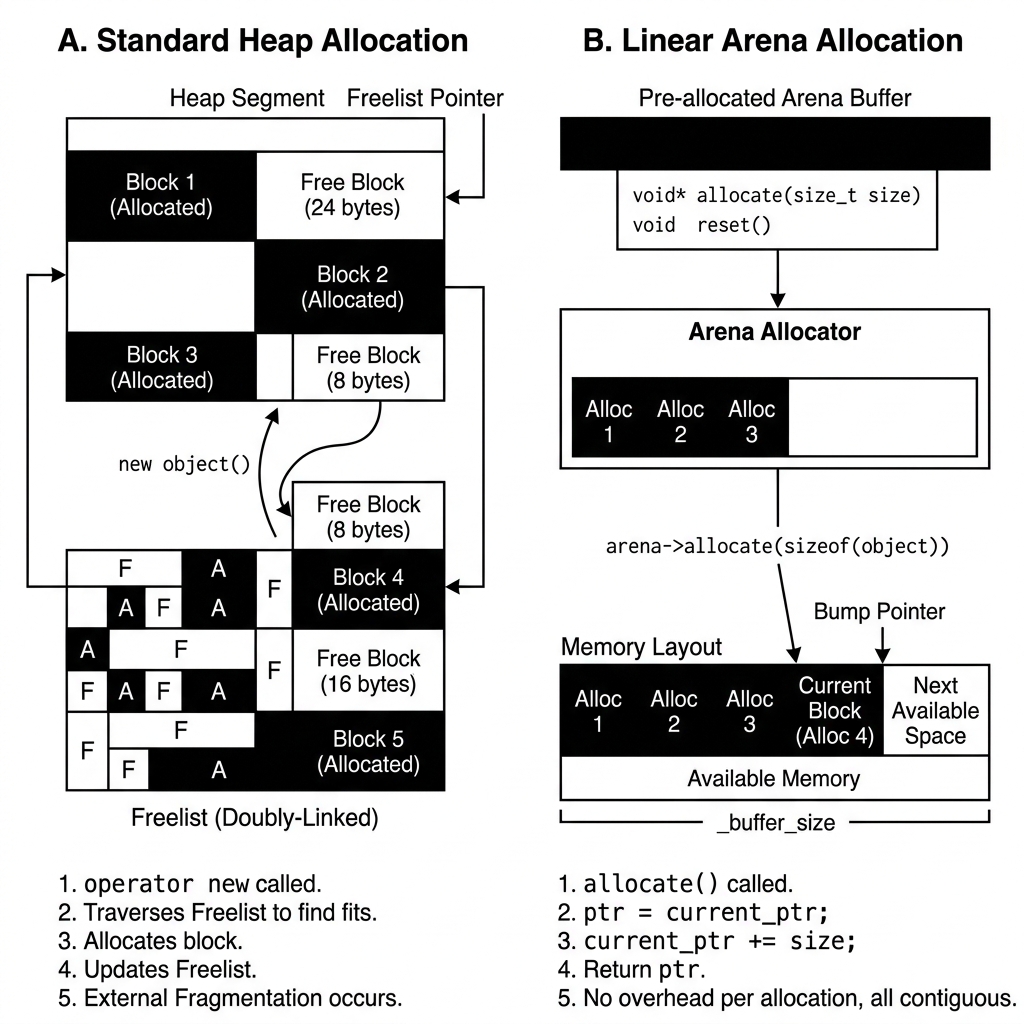
LinearArena vs. Heap Allocations
In HPC, calling malloc or new inside hot calculation loops is prohibitively slow because they must search the heap’s free list and synchronize across threads. LinearArena yields substantial speedups by reducing allocations to a simple pointer addition.
Standard malloc/new:
    Call malloc() -> lock heap -> search block -> split block -> return ptr (Slow)

LinearArena::allocate():
    Check capacity -> return buffer_ + offset -> bump offset (Extremely Fast, O(1))
| Allocation Strategy | Cycles per Allocation | Thread Synchronization | Fragmentation |
|---|---|---|---|
Standard malloc / new | ~50 - 300 cycles | Yes (mutex contention) | High |
LinearArena (O(1) bump) | ~2 - 5 cycles | No (thread-local) | Zero |
Smart Pointer Overhead
While std::unique_ptr is zero-cost, std::shared_ptr (used in Tensor) has measurable runtime overhead:
- Memory Overhead: The control block contains two ref counts (strong and weak) and the deleter. This requires an extra heap allocation if not constructed using
std::make_shared. - Atomic Overhead: Copying and destroying a
std::shared_ptrrequires thread-safe atomic increments (lock xaddon x86).
On modern x86 architectures:
- An atomic increment/decrement takes ~20 - 100 cycles depending on cache line contention.
- A standard variable increment takes ~1 cycle.
Therefore, you should avoid copying Tensor objects by value in performance-critical loops. Pass them by const reference (const Tensor&) to avoid modifying the reference count.
HPC-Specific Anti-Patterns
When applying RAII to high-performance systems, engineers often fall into several common traps.
The “Moved-From Zombie” Anti-Pattern
After an object has been moved, it is in a “valid but unspecified” state. For RAII containers, this state is typically nullptr or empty. Accessing fields of a moved-from object results in undefined behavior or null pointer dereferences.
// ANTI-PATTERN
LinearArena arena(1024 * 1024);
LinearArena new_arena = std::move(arena); // arena is now a zombie (buffer_ = nullptr)

// CRASH! Accesses nullptr
uint8_t* ptr = arena.allocate(128);
Fix: Do not access moved-from objects. Treat them as dead, or explicitly reinitialize them:
LinearArena new_arena = std::move(arena);
arena = LinearArena(1024 * 1024 * 2); // Reinitialize with a new resource
uint8_t* ptr = arena.allocate(128);   // Safe
The “Shared Everything” Anti-Pattern
Using std::shared_ptr on every intermediate layer metadata object because “it prevents leaks” introduces unnecessary heap allocations and atomic ref count updates.
// ANTI-PATTERN
class Layer {
    std::shared_ptr<std::vector<int>> shape_;
    std::shared_ptr<std::vector<int>> strides_;
    // ...
};
Fix: Keep metadata on the stack or as direct value members. Only share the actual high-volume memory payloads (like Tensor::data_ buffers) using std::shared_ptr.
// SAFE
class Layer {
    std::vector<int> shape_;   // Direct member
    std::vector<int> strides_; // Direct member
    // ...
};
Two-Phase Initialization (Fake RAII)
Writing classes that define constructors but require calling an explicit .init() method, and define destructors but require calling .shutdown().
// ANTI-PATTERN
class DeviceContext {
public:
    DeviceContext() = default; // Does not acquire context
    bool init();               // Manual initialization
    void shutdown();           // Manual release
    ~DeviceContext() = default; // Silent leak if shutdown() is forgotten!
};
If a function exits early due to an error or an exception after .init() but before .shutdown(), the resources are leaked.
Fix: Put resource acquisition inside the constructor, and release in the destructor. If the setup fails, throw an exception from the constructor:
// CORRECT
class DeviceContext {
public:
    DeviceContext() {
        if (!acquire_context()) {
            throw std::runtime_error("Context acquisition failed");
        }
    }
    ~DeviceContext() {
        release_context(); // Automatic
    }
};
Best Practices Checklist
| Rule | Why |
|---|---|
Never use new/delete directly | Use std::unique_ptr, std::shared_ptr, or custom RAII containers. |
| Delete copies for unique resources | Prevent duplicate pointer handles from double-freeing. |
Make destructors noexcept | Throwing destructors during stack unwinding calls std::terminate. |
| Pass Tensors by const reference | Avoid atomic reference counting overhead inside math loops. |
| Name your RAII objects | Unnamed temporaries (e.g. std::lock_guard<std::mutex>(mtx);) die immediately. |
| Apply the Rule of Zero | Combine standard RAII types to avoid writing custom lifecycle boilerplate. |
| Release resources in reverse order | Match stack destruction conventions (last in, first out). |
Conclusion
RAII is a fundamental safety pillar in modern C++. It transforms resource lifetime management into a static, compile-time guarantee: if your code compiles and your types are correct, your resources are managed safely without garbage collection or manual tracking overhead.
By utilizing wrappers like LinearArena to control raw memory blocks and std::shared_ptr inside Tensor structures to manage shared zero-copy views, high-performance systems can achieve both execution speed and complete memory safety.
Further Reading:
- Bjarne Stroustrup, The C++ Programming Language, 4th Edition — §13.3 “Resource Management”
- Bjarne Stroustrup, The Design and Evolution of C++ — where RAII was first named
- Scott Meyers, Effective Modern C++ — Items 18–22 on smart pointers
- Herb Sutter & Andrei Alexandrescu, C++ Coding Standards — Item 13: “Ensure resources are owned by objects”
- Herb Sutter, Exceptional C++ — Items 8–19 on exception safety and RAII
- Andrei Alexandrescu, “Systematic Error Handling in C++” — scope guards and RAII
- ISO/IEC 14882:2020 (C++20 Standard) — §6.7.3 “Automatic storage duration”, §14.4 “Stack unwinding”
- CppReference:
std::unique_ptr,std::shared_ptr,std::lock_guard,std::jthread - Jason Turner, C++ Best Practices — RAII sections
- Arthur O’Dwyer, “Back to Basics: RAII and the Rule of Zero” (CppCon 2019)
Enjoy Reading This Article?
Here are some more articles you might like to read next: