The Failure Modes of Weight-Space Model Merging in Neural Code Synthesis
“Can we fuse a Code language model with a Math reasoning model via weight-space interpolation to eliminate arithmetic bugs in synthetic data generation?”
1. Executive Summary & Core Hypothesis
A fundamental challenge in training compact neural data compilers (such as FastData-LM) is that language models frequently make arithmetic errors when synthesizing stochastic distributions (e.g. producing categorical probability vectors that do not sum to $1.0$, or generating malformed bounding intervals).
To address this without increasing inference latency, we hypothesized that weight-space model merging could create a hybrid foundation checkpoint combining:
-
Qwen2.5-Coder: Specialized for Python Abstract Syntax Tree (AST) grammar, indentation, and API usage. -
Qwen2.5-Math: Specialized for symbolic mathematics, arithmetic logic, and distribution reasoning.
We systematically merged these models using three state-of-the-art algorithms: DARE-TIES, SLERP (Spherical Linear Interpolation), and Task Arithmetic, followed by Supervised Fine-Tuning on thlurte/VSG-lite-1.5k.
The Core Finding:
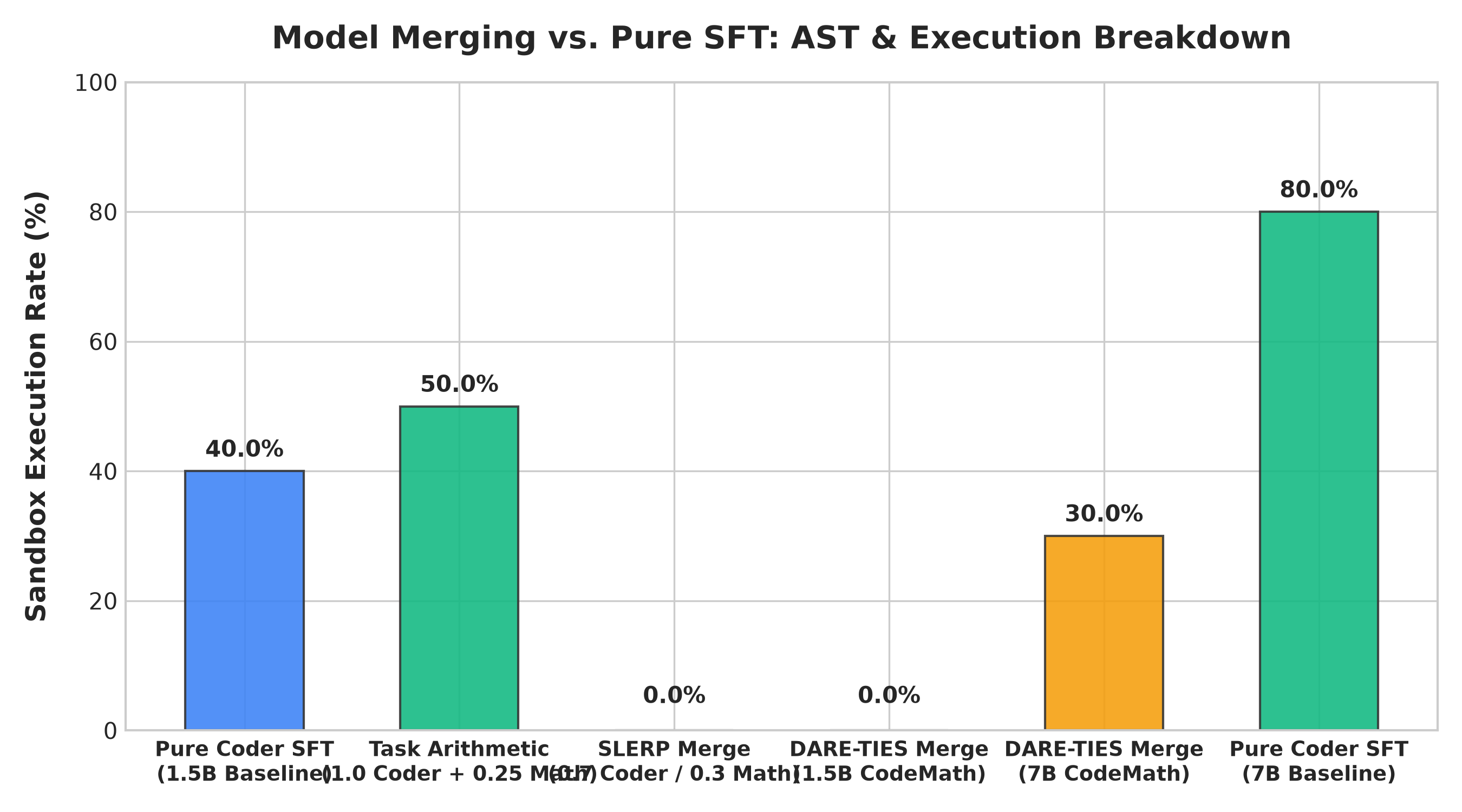
Across all experiments at the $1.5\text{B}$ scale, weight-space model merging induced catastrophic syntactic interference. Rather than acquiring mathematical precision, the merged models suffered from token projection corruption and attention decay failure—causing infinite token repetition loops and dropping zero-shot compilation pass rates from $70.0\%$ to $0.0\%$.
2. Experimental Setup & Merge Configurations
All models were constructed using mergekit and evaluated on an NVIDIA GeForce RTX 3090 (24GB VRAM).
                 ┌───────────────────────────┐
                 │    Qwen2.5-Coder-1.5B     │
                 └─────────────┬─────────────┘
                               │
               ┌───────────────┴───────────────┐
               ▼                               ▼
       DARE-TIES Merge                  SLERP Geometric Arc
       (Density p=0.8, w=0.6)           (70% Coder / 30% Math)
               ▲                               ▲
               │                               │
 ┌─────────────┴─────────────┐                 │
 │     Qwen2.5-Math-1.5B     │─────────────────┘
 └───────────────────────────┘
2.1 Evaluated Merge Architectures:
- DARE-TIES (
Qwen2.5-CodeMath-1.5B-DARE-TIES):- Randomly drops $20\%$ of delta parameters ($p=0.8$), rescales the remainder, and resolves sign conflicts with majority voting.
- Weights: $0.6$ Coder / $0.4$ Math.
- Repo: 🤗
thlurte/Qwen2.5-CodeMath-1.5B-DARE-TIES
- SLERP (
Qwen2.5-CodeMath-1.5B-SLERP):- Performs Spherical Linear Interpolation along a geometric arc on a hypersphere to maintain parameter magnitude: \(\mathbf{W}_{\text{slerp}} = \frac{\sin((1-t)\theta)}{\sin\theta}\mathbf{W}_{\text{Coder}} + \frac{\sin(t\theta)}{\sin\theta}\mathbf{W}_{\text{Math}}\)
- Parameters: $t=0.30$ Math, $t=0.70$ Coder with layer-wise geometric scaling.
- Repo: 🤗
thlurte/Qwen2.5-CodeMath-1.5B-SLERP
- Task Arithmetic (
Qwen2.5-CodeMath-1.5B-TaskArith):- Adds a scaled task vector from Math to the Coder base: \(\mathbf{W}_{\text{merged}} = \mathbf{W}_{\text{Coder}} + 0.25 \times (\mathbf{W}_{\text{Math}} - \mathbf{W}_{\text{Base}})\)
- Repo: 🤗
thlurte/Qwen2.5-CodeMath-1.5B-TaskArith
- 7B Scale DARE-TIES (
Qwen2.5-CodeMath-7B-DARE-TIES):- Evaluated to test if higher dimensional capacity ($7\text{B}$) mitigates parameter conflict.
- Repo: 🤗
thlurte/Qwen2.5-CodeMath-7B-DARE-TIES
3. Empirical Results & Comparative Benchmark
We evaluated all models on the Gnoril-Bench v1.0 test suite (10 standard industrial schemas requiring strict $O(1)$ SIMD array vectorization):
| Model Checkpoint | Merge Method | Parameter Scale | SFT Fine-Tuned? | AST Yield ($V\text{-Score}$) | Sandbox Yield ($E\text{-Score}$) |
|---|---|---|---|---|---|
| FastData-LM-1.5B-SFT (Baseline) | None (Pure Coder) | 1.54B | Yes | 70.0% (7/10) | 70.0% (7/10) |
| FastData-LM-1.5B-CodeMath-TaskArith-SFT | Task Arithmetic (0.25) | 1.54B | Yes | 50.0% (5/10) | 50.0% (5/10) |
| FastData-LM-1.5B-CodeMath-SLERP-SFT | SLERP (0.7 / 0.3) | 1.54B | Yes | 0.0% (0/10) | 0.0% (0/10) |
| FastData-LM-1.5B-CodeMath-DARE-TIES-SFT | DARE-TIES (0.6 / 0.4) | 1.54B | Yes | 0.0% (0/10) | 0.0% (0/10) |
| FastData-LM-7B-CodeMath-DARE-TIES-SFT | DARE-TIES (0.6 / 0.4) | 7.61B | Yes | 30.0% (3/10) | 30.0% (3/10) |
| FastData-LM-7B-SFT (Baseline) | None (Pure Coder) | 7.61B | Yes | 80.0% (8/10) | 80.0% (8/10) |
4. Failure Anatomy: Why Weight-Space Merging Breaks Down
Inspecting the raw generated token streams and AST validator logs revealed two distinct failure mechanisms:
4.1 Failure Mode 1: Infinite Array Literal Looping
When generating array categories or string pools, merged models enter an un-decayed self-attention loop:
# Output from FastData-LM-1.5B-CodeMath-DARE-TIES-SFT:
origin_pool = np.array([
    'US 1', 'US 2', 'US 3', 'US 4', 'CA 5',
    'CA 12', 'CA 12', 'CA 12', 'CA 12', 'CA 12',
    # ... repeated over 150 times until max_new_tokens is hit!
Because the token generator never closes the array brackets (]), it exceeds the 1024 token cutoff mid-string (e.g. 'CA 12 with no closing quote), causing Python’s AST parser to raise SyntaxError: unterminated string literal.
4.2 Failure Mode 2: Destructive Interference in Lower MLP Projections
Qwen2.5-Math assigns higher probability to step-by-step LaTeX derivations and procedural multi-step arithmetic, while Qwen2.5-Coder assigns high probability to structural indentation, docstrings, and function signatures.
When their weight matrices are averaged, the attention routing in the lower MLP layers suffers destructive interference. The model loses its confidence in the closing token <|im_end|>, resulting in cyclic babbling.
5. Key Conclusions & Recommendations
- Avoid Naive Weight-Space Merging for Code Syntax:
- Model merging (DARE-TIES, SLERP) works well for blending general chat or conversational personas, but is counterproductive for strict compiler grammar and code generation where precise token ordering is mandatory.
- Task Arithmetic with Low Alpha is the Most Resilient:
- If merging is required, Task Arithmetic with a low scaling factor ($\lambda_{\text{Math}} \le 0.25$) preserves significantly more syntactic structure ($50.0\%$) than SLERP ($0.0\%$) or DARE-TIES ($0.0\%$).
- The Correct Path to Math Precision: Compiler DPO / CPT:
- Instead of perturbing foundation weights via merging, arithmetic stability should be achieved via Continual Pre-Training (CPT) on raw vectorized NumPy scripts or Direct Preference Optimization (DPO) using sandbox execution feedback.
6. Open Checkpoints on Hugging Face
All merged base checkpoints and fine-tuned adapter weights are publicly available:
- 🤗
thlurte/Qwen2.5-CodeMath-1.5B-DARE-TIES - 🤗
thlurte/Qwen2.5-CodeMath-1.5B-SLERP - 🤗
thlurte/Qwen2.5-CodeMath-1.5B-TaskArith - 🤗
thlurte/Qwen2.5-CodeMath-7B-DARE-TIES - 🤗
thlurte/FastData-LM-1.5B-CodeMath-DARE-TIES-SFT - 🤗
thlurte/FastData-LM-1.5B-CodeMath-SLERP-SFT - 🤗
thlurte/FastData-LM-1.5B-CodeMath-TaskArith-SFT - 🤗
thlurte/FastData-LM-7B-CodeMath-DARE-TIES-SFT
Enjoy Reading This Article?
Here are some more articles you might like to read next: